Power to the people (Part 2): On regulation
the governments failure to apply it's own regulation, coupled with multiple attempts to impose uneconomic tariffs on private developers by decree over the past five years has transformed the country from a leader in the space to a cautionary tale for most developers
This is part two of a three-part essay adapted from a position paper I wrote in 2018 as a director at the Africa Mini-grid Developers Association (AMDA). I’ve included part one here. It has been edited for clarity and to account for developments over the past six years.
Photo by Michael Förtsch on Unsplash
A tale of three countries
Africa lacks a unified regulatory approach to DERs making it difficult for developers to scale beyond a single country. This limits private sector participation in electrification. Convergence around a core set of DER regulation would help private sector developers grow by providing certainty around important questions such as quality standards, tariff regulation, access to finance and procedures for grid interconnection. Three markets: Nigeria, Kenya and Tanzania illustrate the diversity of regulatory environments in Africa
Nigeria
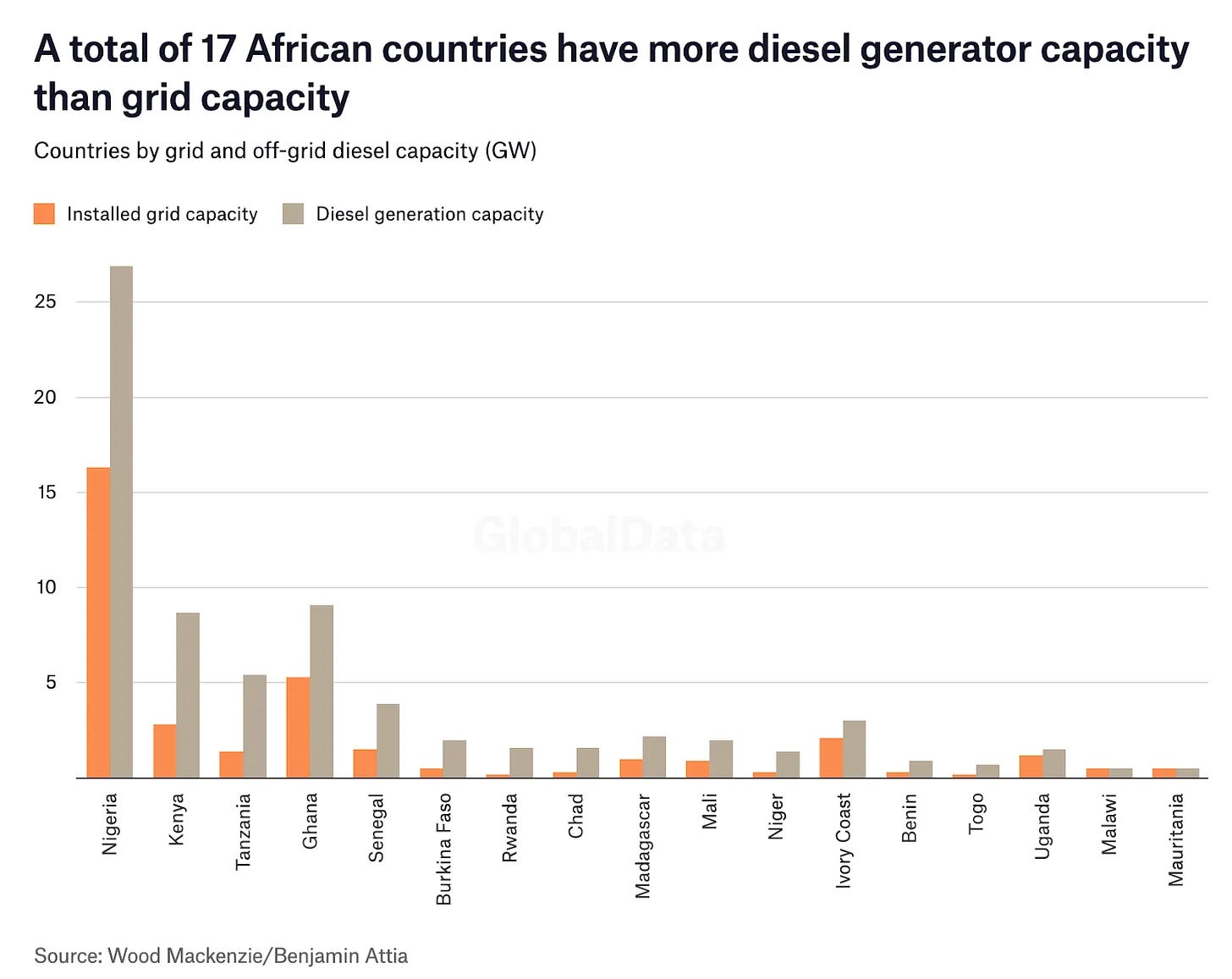
Nigeria’s total installed power capacity is estimated at around 17 GW. However, only half of the installed capacity is actually available due to outdated technology and poor maintenance of the grid. More tellingly, the country has over 25GW of diesel generator capacity, underscoring the grids extreme inability to meet demand. The country wants to increase its generating capacity to 30 GW of power by 2030 with 30% (10 GW) of this coming from renewable sources. Of this 10 GW, 5.3 is intended to come from DERs creating a strong mandate for the sector. To support this agenda the World Bank is currently contributing USD 350M to energy projects in Nigeria with USD 150M earmarked for DERs.
Nigeria’s total installed power capacity is estimated at around 13 GW. However, only half of the installed capacity is actually available due to outdated technology and poor maintenance of the grid.
In 2017, the Nigerian Electricity Regulatory Commission (NERC) issued one of the most private sector friendly regulations for DERs worldwide. It comprises of:
- A standardized tariff calculation methodology and tool based on the cost plus method combined with a process for tariff adjustments over time,
- A clear compensation mechanism for assessing the value of the assets of a company in case these need to be sold to a Distribution Company (DISCO),
- Technical and safety standards,
- Regulations for so-called Interconnected Mini-Grids (DERs that can work in a stand alone mode but can also buy electricity from and sell electricity to the DISCO connected to the mini-grid under a tripartite agreement between the mini-grid operator, the DISCO and the connected community).
This is supposed to foster Smart Grid approaches starting from a mini-grid nucleus on the one hand, while reactivating existing but poorly operated distribution networks of DISCOs on the other hand.
Tanzania
Tanzania currently has about 109 mini-grids, serving over 180,000 people. Tanzania mini-grids account for 157.7 MW of installed capacity spread across a variety of energy sources including hydro, biomass, hybrid, fossil fuel and solar. The country estimates that about half the rural population may be more cost-effectively served by decentralized options than by centralized grid expansion.
In 2008, Tanzania adopted a new regulatory framework to encourage low-cost investment in mini-grids, called the small power producers (SPP) framework, which caused the number of mini-grids to double. The financial mechanism created (a feed-in tariff) was technology neutral, which favored biomass and hydro development with low generation cost. However, a 2015 revision to the policy encouraged solar and wind development. In 2017 Tanzania’s Energy and Water Utilities Regulatory Authority (EWURA), the national regulator, approved a third generation mini-grid framework.
The third generation rules provide several important improvements to create an enabling regulatory environment. The rules cover the following aspects:
- A provision for mini-grids at multiple locations to operate under a single license (above 1 MW),
- An exemption from tariff regulation for mini-grids below 100 kW,
- A definition for customers that are exempt from tariffs reviewed by EWURA,
- An allowance for grid-connected mini-grids to operate in islanded mode when power supply is not available from the main grid,
- Some clarity and credibility on the calculation of the limited compensation for distribution assets when the main grid connects to a previously isolated mini-grid.
Although these improvements are steps in the right direction, there are limitations on the grid integration framework creating significant ambiguity in implementation. Additionally the lack of clarity on grid expansion planning increases the risk to developers and their investors. The existing framework lacks sufficent security guarantees for investors and financiers.
Finally, the governments failure to apply it’s own regulation, coupled with multiple attempts to impose uneconomic tariffs on private developers by decree over the past five years has transformed the country from a leader in the space to a cautionary tale for most developers. This highlights the central role that regulatory consistency plays in building a sustainable DER sector.
the governments failure to apply it’s own regulation, coupled with multiple attempts to impose uneconomic tariffs on private developers by decree over the past five years has transformed the country from a leader in the space to a cautionary tale for most developers
Kenya
Kenya’s current installed capacity sits at about 2400 MW with the bulk of this power coming from geothermal and large hydro sources. The country has robust private sector participation in power generation but lacks clear frameworks to encourage such participation in Transmission and distribution. The national utility, Kenya Power, along with the Rural Electrification Agency (REA) have been working together since 2006 to increase rural electrification through the Last Mile Connectivity Program (LMCP), funded by the World Bank. The program provides a connection subsidy to Kenya Power for each household connected to the national grid.
Kenya Power and REAs objectives for Kenya’s distribution system include building a stronger and more flexible grid by building in redundancies, reducing losses, and adding in smart technologies. They also aim to Increase renewable off-grid access by hybridizing 19 off-grid diesel-powered stations and adding 43 greenfield solar mini-grids.
The regulatory environment governing DERs has been hampered by the stalling of the 2015 National Energy policy and Bill which is meant to bring clarity on key issues such as the procedure for mini-grid - main grid interconnection. Current regulation provides guidance on licensing requirements for DERs based on size of generation. Installations smaller than 3MW are required to apply for a permit while larger installations require a full licence. The lack of a full DER policy has slowed growth in the Kenya mini-grid sector with many developers holding off on development as they await regulatory clarity. The new bill is expected to reduce the regulatory burden for developers in part by providing guidelines for the use of national funds for DER development, and clarifying the national electrification strategy.
The variance in regulatory environments in Africa is one of the key issues that AMDA looks to address by building consensus among developers on what policies are best suited to supporting the growth of the sector and communicating this to policy makers and sector enablers. The association also aims to ensure that developers adhere to high quality standards when building grids in order to ensure that the sector lives up to the service expectations of both governments and funders.
The third and final post in this series will be out next week and will explore how various financing approaches help or hinder the growth of DERs across Africa.
First published on Substack.